 English
 Deutsch
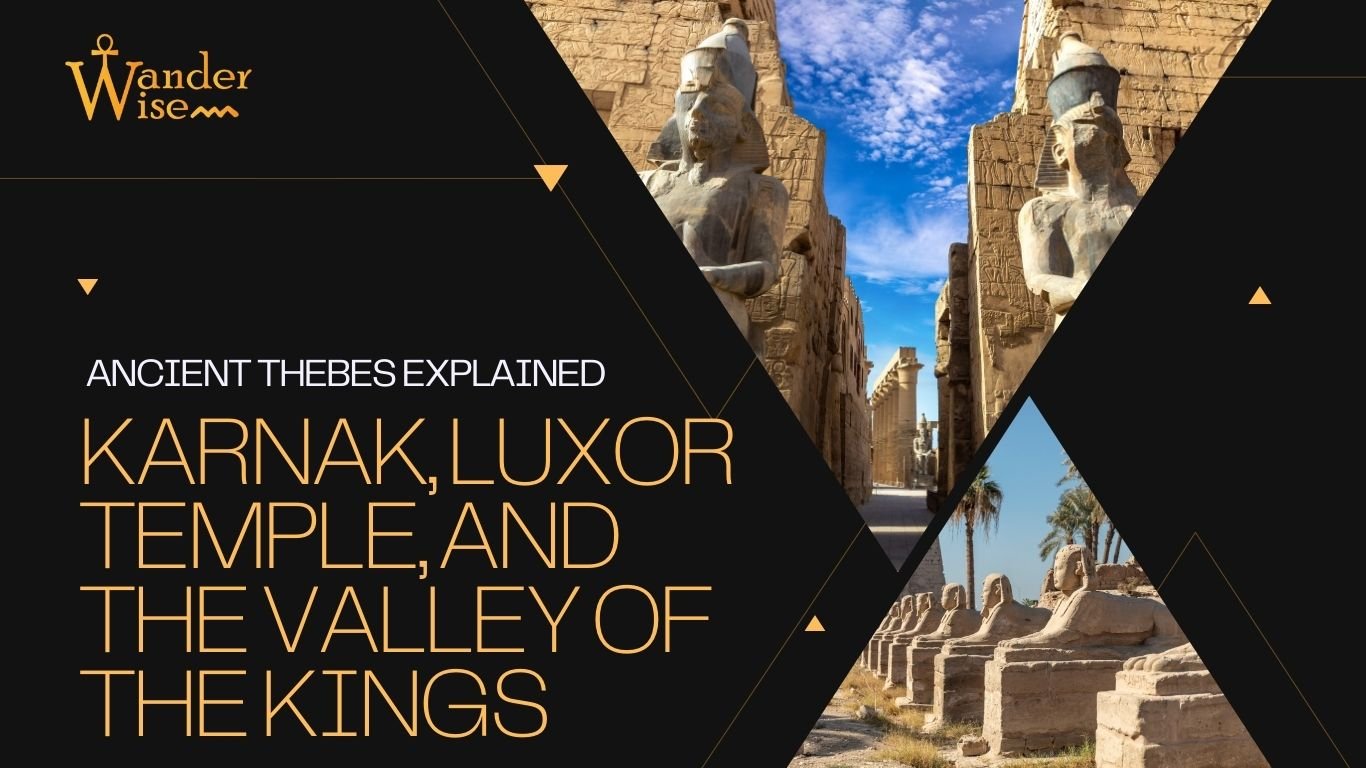
Ancient Thebes isn’t one temple. It’s the whole ancient city area around modern Luxor. Think of it like a giant open-air history zone, split by the Nile into two different worlds.
If you’ve ever looked at a Luxor map and thought, “Why are the famous places on both sides of the river?”, this article is here to make that click.
In plain English:
-
The East Bank was the everyday side. People lived there, worked there, traded there, and worshipped in huge temples.
-
The West Bank was linked with burial and the afterlife. That’s why the big tomb areas and many memorial temples sit against the cliffs on that side.
So when you hear someone talk about “doing Luxor”, they’re usually talking about doing both sides. That’s why plans can feel confusing at first. You might start at Karnak Temple on the East Bank, then cross the Nile for the Valley of the Kings on the West Bank, then come back again. It isn’t random. It’s how the ancient city was organised.
This guide explains Ancient Thebes through three places you’ll keep hearing about:
-
Karnak Temple: the huge temple complex that grew over a very long time
-
Luxor Temple: the temple linked to festivals and processions along the river
-
The Valley of the Kings: the royal tomb area, set away from the city
You don’t need to remember every pharaoh’s name to enjoy any of this. You just need a few simple ideas:
-
what each place was used for
-
how the places connect
-
what order makes sense when you visit
If you’re planning a trip, keep this page as your “why it matters” read, then use these practical pages when you want to build a real plan:
-
Luxor planning hub: https://wanderwisetours.com/luxor-guide/
-
Day trip planning from the Red Sea: https://wanderwisetours.com/hurghada-to-luxor-day-trip-2026/
-
Private touring option in Luxor: https://wanderwisetours.com/st_tour/private-tour-to-luxor-temples/
Next, we’ll do the easiest part that fixes most confusion: East Bank vs West Bank, with a quick “what goes where” list you can use while planning.
East Bank vs West Bank in Luxor (the simple way to plan)
If you remember one thing about Ancient Thebes, make it this: the Nile splits Luxor into “living” and “afterlife” sides.
East Bank: the “living city” side
The East Bank is where daily life happened. It’s where you’ll find the biggest temple spaces for worship and major public events.
On the East Bank you’ll usually visit:
-
Karnak Temple (the giant temple complex)
-
Luxor Temple (right in town, easy to reach)
-
Museums, hotels, cafés, shops, and the riverside walk
This side is easier for evenings. If you want a relaxed night, it’s simple to step out, eat, and walk along the river without planning transport.
West Bank: the “afterlife” side
The West Bank is where the cliffs rise and the tomb areas sit. In ancient beliefs, the west was linked to the setting sun, so it became connected with endings, death, and what comes after life.
On the West Bank you’ll usually visit:
-
Valley of the Kings (royal tombs)
-
Hatshepsut Temple (big terraces, open views)
-
Other memorial temples and quiet ruins spread out across the desert edge
West Bank visits often feel more intense. There’s more heat, more steps, and more walking between spots.
A quick memory trick
-
East Bank = life (town, temples used by crowds)
-
West Bank = afterlife (tombs, memorial places)
The easiest way to build your day
Most first-timers enjoy Luxor more when they avoid zig-zagging across the river all day. Try one of these simple shapes:
Option A: West Bank morning, East Bank afternoon
-
Do tombs early so it feels cooler
-
Cross back for Karnak or Luxor Temple later
Option B: East Bank morning, West Bank afternoon
-
Start at Karnak when you feel fresh
-
Cross after lunch for the Valley of the Kings and one temple
Both work. The best one is the one that fits your start time and your energy.
Where should you stay?
If you’re spending a night in Luxor:
-
Stay on the East Bank if you want easy evenings and lots of food choices.
-
Stay on the West Bank if you want a quieter feel and shorter morning drives to the tomb areas.
If you’re doing a long day out from the Red Sea, you’ll be in and out, so the key thing is route order and good rest breaks. This planning page helps you picture the travel day:
https://wanderwisetours.com/hurghada-to-luxor-day-trip-2025/
Karnak Temple (what it was for, and what to notice fast)
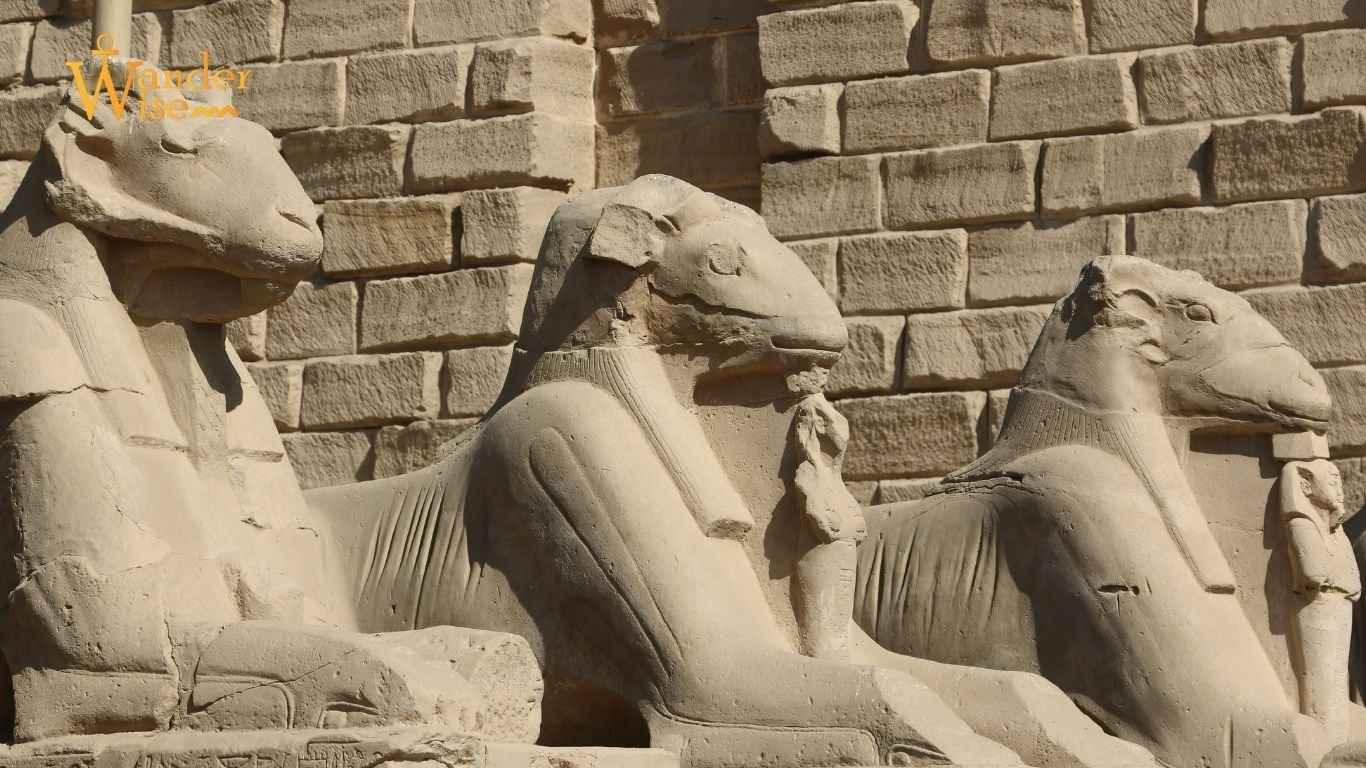
Karnak Temple is not “one building”. It’s a huge religious centre that grew bit by bit over a very long time. Picture a school that kept adding new halls, new gates, new courtyards, and new walls every time a new headteacher arrived and wanted their name on something. That’s the vibe here, except the “school” is a place built for gods, kings, and big public ceremonies.
What Karnak was for (in plain words)
In Ancient Thebes, Karnak was one of the main places where people connected with the gods. It wasn’t only about quiet prayer. It was tied to authority as well.
Karnak did three big jobs:
-
Worship: priests looked after the temples and carried out daily rituals.
-
Festival days: the city had big events where statues of gods were moved and honoured.
-
A message of authority: rulers added new parts to prove they were strong, rich, and “chosen”.
So when you walk through Karnak today, you’re not just seeing nice stones. You’re seeing a place that told everyone, “This city matters.”
The fast way to enjoy Karnak without getting lost
Karnak is massive, so it helps to pick a few things to focus on. If you try to notice everything, it can blur together.
Here are the parts most first-timers remember best:
1) The big forest of columns
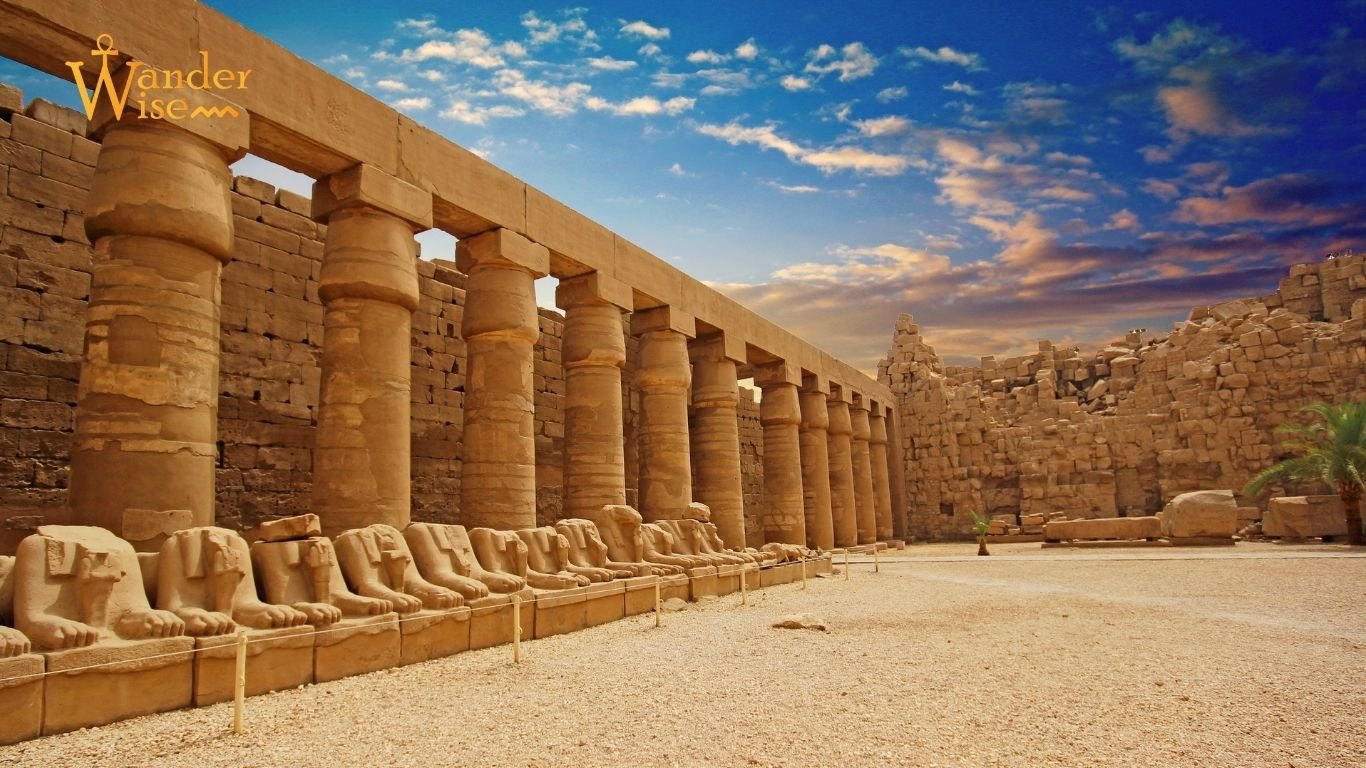
At some point you’ll walk into a space full of thick columns. It can feel like a stone jungle. Look up. Many columns are taller than you expect, and some still have colour on them. Small bits of paint can change how you picture the past, since it shows these places were not plain grey.
Quick tip: step back, stand still for ten seconds, and let your eyes travel from the floor to the top. That pause makes the place feel real.
2) The gateways and straight lines
Karnak has huge gateways that line up like a path through time. These are not random doorways. They guide you through the complex and make you walk the route the planners wanted you to take. When you pass under one, look ahead and spot the next one in the distance. It helps you see how the space was designed to impress.
3) The sacred lake area
Away from the busiest parts, there’s a lake that was used for temple life. It’s calmer here, and it gives your legs a break. It helps you picture the “working” side of the place: washing, cleaning, and getting ready for rituals.
If your group is getting temple tired, this is a good place to slow down for a minute.
4) Carvings that are more like posters than decoration
Some walls are covered with images and writing. Try not to treat them like wallpaper. A lot of it is messaging: who is in charge, who won a fight, who gave gifts to the gods. You might not read it, but you can spot patterns: the ruler shown larger than others, the repeated symbols, the rows of figures.
How long do you need at Karnak?
For a day trip, many people spend around 60–90 minutes on a first visit, which is enough to get the main feel. If you have more time, you can stay longer and explore quieter corners.
Luxor Temple (why it feels different to Karnak, and how they connect)
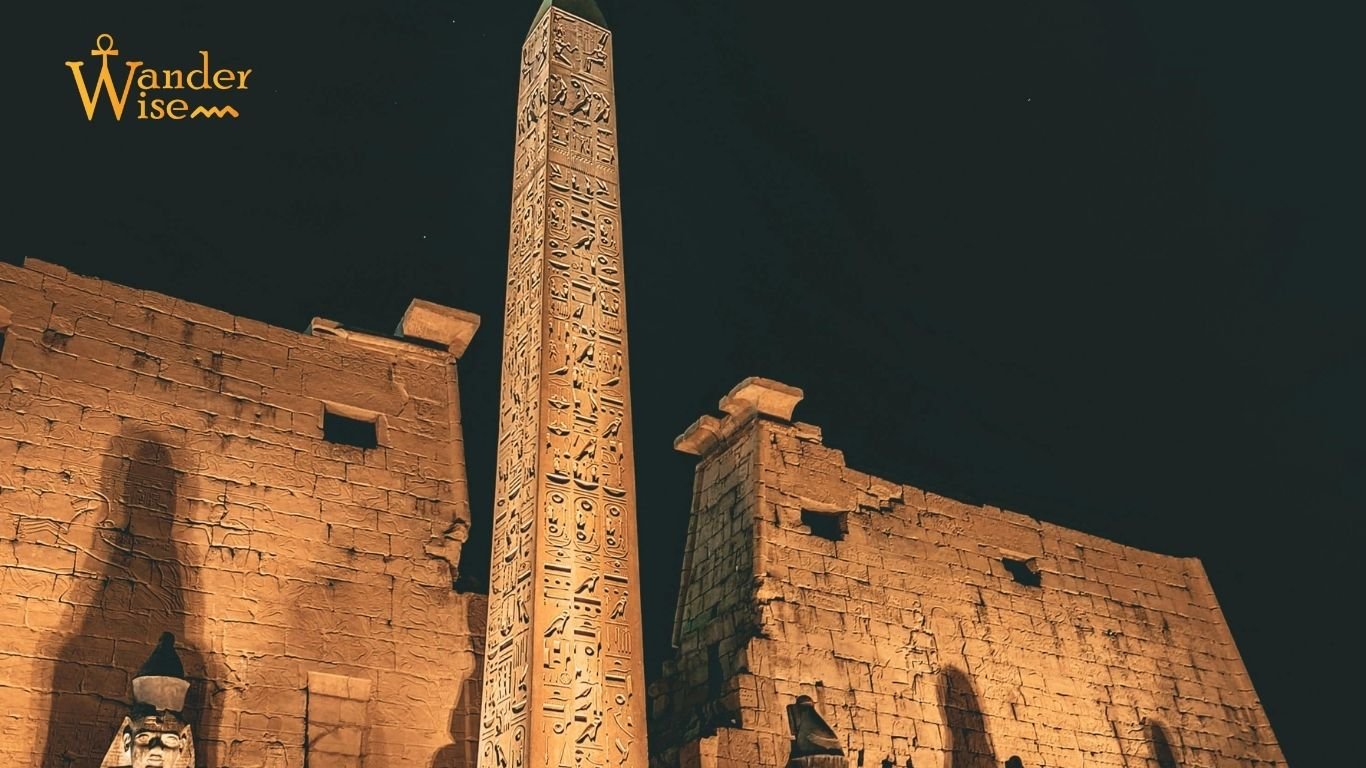
If Karnak feels like a giant city of temples, Luxor Temple feels more like a perfect “main street” monument.
It’s smaller than Karnak, easier to walk, and it sits right by modern Luxor, so it feels like the past and present are sharing the same space. That’s why lots of people finish their day here. It’s simpler, calmer, and it can feel a bit magical in the late afternoon.
What Luxor Temple was for (simple version)
Luxor Temple was strongly linked to big public events, especially festival time. Think of it as a place for important ceremonies that connected:
-
the gods
-
the ruler
-
the city’s sense of order and power
So while Karnak is a massive religious centre with many parts, Luxor Temple is more like a focused “ceremony space” that makes a strong impression fast.
Why Luxor Temple feels so different to Karnak
Here are the main reasons first-timers notice the difference:
1) It’s more “human-sized” to explore
Karnak can feel endless. Luxor Temple feels more like a single story you can follow from start to finish without getting lost. You walk in, you move forward, you see the main areas, and you’re done.
That’s great on a busy day because your brain can actually take it in.
2) It’s right in town
With Karnak you’re visiting a huge ancient space a bit away from everyday life. With Luxor Temple, you might hear traffic or see street lights nearby. Some people think that ruins the mood. Other people love it, because it reminds you this isn’t a museum behind glass. This is a real place that’s been part of the city area for a very long time.
3) It’s brilliant at the end of the day
Luxor Temple can feel especially nice later in the day when the heat drops and the light softens. If you’ve spent time in tombs or big open spaces, Luxor Temple is a simpler finish that doesn’t demand as much energy.
How Karnak and Luxor Temple are linked
Here’s the easy way to picture it:
-
Karnak was the giant religious centre with lots of space and many parts.
-
Luxor Temple was tied to key ceremonies and festival moments.
-
The two were connected by a long route through the city. On festival days, the movement between them mattered. It wasn’t just “travel”. It was part of the meaning.
So if you visit Karnak and Luxor Temple in the same day, you’re not doing two random temples. You’re seeing two places that worked together in the ancient city’s public life.
Quick “what to notice” checklist at Luxor Temple
If you want your visit to feel more meaningful without needing a big history lecture, focus on these:
-
The main straight route through the temple: it’s designed to guide you forward
-
Big entrances and gateways: built to impress, not just to let people in
-
Carvings and repeated scenes: often more like public messaging than decoration
-
How close it is to the river and the city: it helps you picture it as part of a living place, not a lonely ruin
Can you fit Luxor Temple into a Hurghada day trip?
Sometimes, yes. But treat it as a bonus.
On a Hurghada to Luxor day trip, most time goes to Karnak + the West Bank (Valley of the Kings and one big temple). If timing is smooth and your group is moving quickly, Luxor Temple can work as a final stop. If not, it’s the first thing that gets cut.
Valley of the Kings (why the tombs are on the West Bank, and how to enjoy your visit)
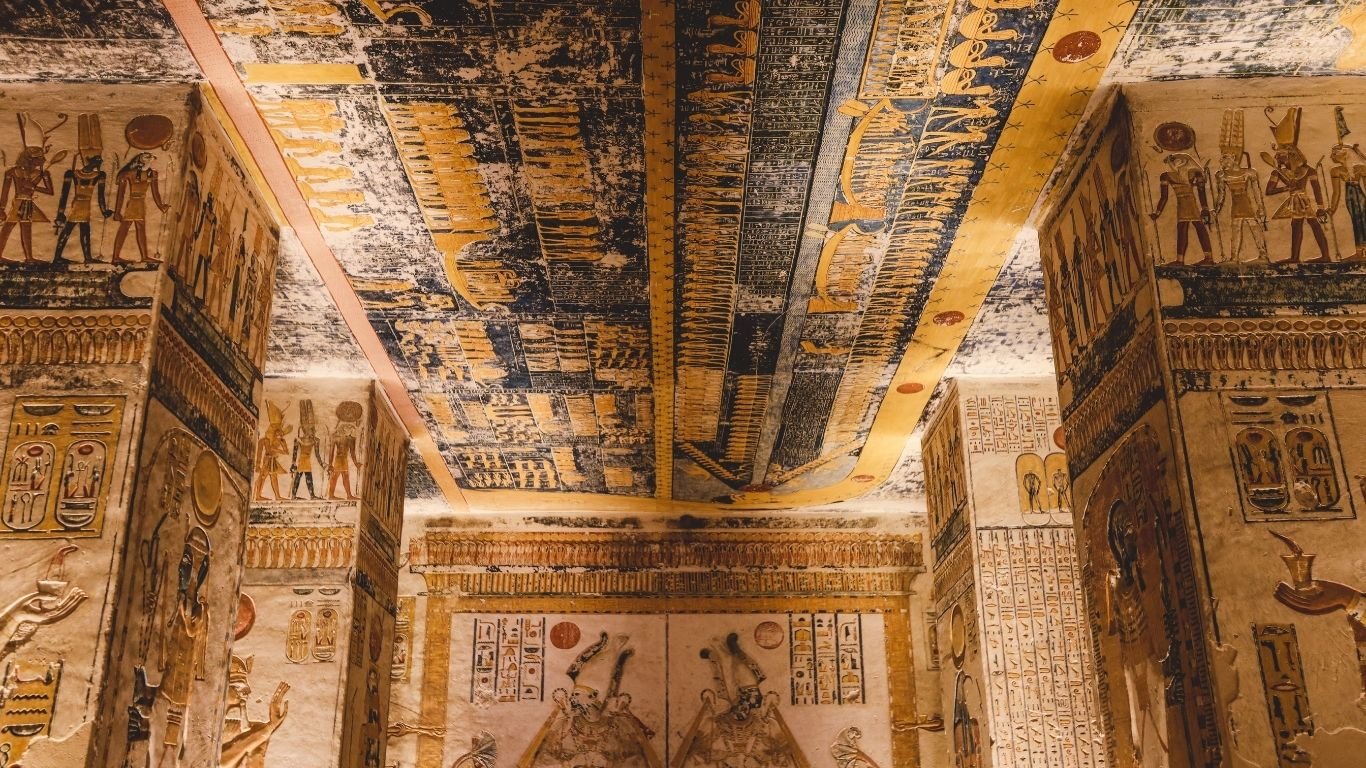
The Valley of the Kings is the place most people picture when they hear “Luxor”. It’s a dry valley tucked into the cliffs on the West Bank, away from the busy town. This isn’t an accident. In ancient belief, the west side of the river was linked with the setting sun, so it became the “afterlife” side. That’s why the royal tombs sit out here rather than in the middle of the city.
Why the tombs are here (the quick logic)
There are three simple reasons the Valley of the Kings ended up in this spot:
-
Privacy and control: a hidden valley is easier to guard than a tomb in a neighbourhood.
-
Rock and terrain: the cliffs and slopes made it easier to cut tombs into stone.
-
Symbolism: the West Bank already carried strong afterlife meaning, so it matched the purpose.
It still didn’t stop tomb robbing over time, but the location shows what the planners wanted: separation from everyday life.
What a first visit feels like
This is the bit people don’t always expect. Tomb visits can feel intense.
-
It’s warmer inside than you think, especially if there’s a queue.
-
There are steps and ramps, so good shoes matter.
-
Tombs can feel similar if you rush from one to the next. If you slow down, you start spotting the difference.
If someone in your group hates tight spaces, plan fewer tombs and add more open-air stops like Hatshepsut Temple or Karnak.
How many tombs should you do?
For most first-timers, 2–3 tombs is a sweet spot on a busy day. It gives you time to look properly without feeling wiped out.
A simple trick: make the first tomb your “slow tomb”. Spend longer there. Look at the walls properly, not just the signboards. After that, you can do one or two shorter visits.
The biggest mistake on day trips
On a long Hurghada-to-Luxor day, people often arrive at the Valley of the Kings already tired, then try to do too much, too fast. That’s when everyone gets grumpy and the place starts feeling like a chore.
If you’re doing it as a day trip, build your day around two main stops:
-
one major temple on the East Bank (often Karnak)
-
the Valley of the Kings on the West Bank
-
then one extra West Bank stop if energy allows
This is the timetable-style guide that matches that reality:
https://wanderwisetours.com/hurghada-to-luxor-day-trip-2025/
Small comfort tips that change the whole visit
-
Go early if you can. Cooler air, shorter queues, better mood.
-
Drink before you feel thirsty. The dry heat sneaks up on you.
-
Keep your bag light. You’ll enjoy the walking more.
-
Take shade breaks on purpose. Five minutes sitting down is not “wasting time”.
If you’re staying longer in Luxor, use the hub plan to spread the West Bank over a calmer day:
https://wanderwisetours.com/luxor-guide/
You’ve now got the big idea of Ancient Thebes: East Bank = public temple life, West Bank = tombs and the afterlife side. Here’s how to turn that into a plan that actually works on the ground.
If you have 1 day in Luxor
Best for: day-trippers and anyone short on time.
Morning (pick one main start)
-
Karnak Temple (East Bank) or
-
Valley of the Kings (West Bank)
Midday
-
Lunch + shade break (treat this as a real stop)
Afternoon
-
If you started East Bank: cross to Valley of the Kings + Hatshepsut Temple
-
If you started West Bank: cross to Karnak Temple (and keep it focused)
Bonus (only if the day runs smoothly)
-
Luxor Temple late afternoon
Day trip planning page (good to link from this section):
https://wanderwisetours.com/hurghada-to-luxor-day-trip-2026/
If you have 2 days in Luxor
Best for: first-timers who want a calmer pace.
Day 1: West Bank day
-
Valley of the Kings
-
Hatshepsut Temple
-
Short photo stop at Colossi of Memnon
-
Early evening back in town
Day 2: East Bank day
-
Karnak Temple (take it slow)
-
Luxor Temple later in the day
Main planning hub to link from this section:
https://wanderwisetours.com/luxor-guide/
If you have 3 days in Luxor
Best for: people who want the “big sites” plus time to breathe.
Day 1: West Bank (tombs + one big temple)
-
Valley of the Kings
-
Hatshepsut Temple
-
Keep one extra slot optional (only if energy is good)
Day 2: East Bank (temples day)
-
Karnak Temple
-
Luxor Temple late afternoon
Day 3: choose-your-own day
Pick one style:
-
A slower Nile day (boat time + relaxed stops)
-
Museum time + easy walking
-
A longer extra outing if your group wants more history
If you want a guided option to link as your “book it” path:
https://wanderwisetours.com/st_tour/private-tour-to-luxor-temples/
FAQ: Ancient Thebes, East Bank, West Bank
What does “Ancient Thebes” mean?
It’s the ancient city area around modern Luxor, including the major temples on the East Bank and the tomb areas on the West Bank.
Why are the tombs on the West Bank?
Because the west side was linked to the setting sun and afterlife beliefs, and the cliff landscape made it practical to cut tombs into rock.
Do I need to see both Karnak and Luxor Temple?
If you can, yes, because they give you two different “sides” of temple life: Karnak is huge and complex, Luxor Temple is more focused and easier to follow.
How do I stop the Valley of the Kings feeling too rushed?
Do fewer tombs and go slower in the first one. Heat and queues are what make it feel tiring, not the history.
What’s the easiest order for first-timers?
Most people find this easiest:
-
One big stop early
-
Lunch and shade break
-
One big stop after lunch
-
Keep any extra stop as a bonus
Comment (0)